If you asked an AI assistant to recommend companies in your industry, would your brand make the list? Most businesses assume good SEO is enough. But new research shows that AI search looks at brand authority very differently than traditional search engines do.
According to Ahrefs’s latest AI Search Benchmark Report, a study spanning 75,000 brands, 174,000 cited pages, 26,000 source URLs, and 108 million queries, you’d be wrong on all three. The single strongest correlate of AI brand visibility isn’t a traditional SEO metric at all.
It’s YouTube mentions, with a correlation coefficient of roughly 0.737 across ChatGPT, AI Mode, and AI Overviews combined. Let that sink in.
That number is worth pondering for a second. Domain Rating? It correlated at just 0.285-0.326. Backlink count? 0.171-0.244. Branded search volume? 0.266-0.392. None of the classic ranking-factor playbook comes close to what YouTube does for AI visibility.
In this post, you will get to know what that finding actually means for your brand visibility, why it’s happening, and more importantly, what to do about it before your competitors figure it out first.
What Drives AI Brand Visibility? Key Ranking Signals Explained
AHREF’s AI Search Benchmark Report tested a wide range of factors against how often brands were mentioned across the three major AI surfaces. Here’s how the signals stacked up:
| Signal | ChatGPT | AI Mode | AI Overviews |
| YouTube mentions | 0.735 | 0.736 | 0.740 |
| YouTube mention impressions | 0.721 | 0.712 | 0.719 |
| Branded web mentions | 0.656 | 0.709 | 0.664 |
| Branded anchors | 0.511 | 0.628 | 0.527 |
| Branded search volume | 0.352 | 0.466 | 0.392 |
| Domain Rating | 0.266 | 0.285 | 0.326 |
| Number of referring domains | 0.271 | 0.307 | 0.295 |
| Branded traffic | 0.235 | 0.357 | 0.274 |
| Number of backlinks | 0.191 | 0.244 | 0.218 |
| Number of site pages | 0.171 | 0.240 | 0.170 |
| URL rating | 0.172 | 0.204 | 0.180 |
A few things are evident immediately.
First, YouTube mentions and YouTube mention impressions occupy the top two spots across every single AI platform tested, not just one.
Second, the gap between YouTube and the next-best signal (branded web mentions) is substantial; roughly 8-12 correlation points, which in a dataset this size is not noise.
Third, and maybe most surprising: link-based and content-volume metrics, the bedrock of classic SEO, barely register. Backlinks and “number of site pages” sit near the bottom of the list across all three platforms.
Business Insider also reports that consistent brand mentions and visibility across trusted channels, including websites, social platforms, and YouTube, play an increasingly important role in how AI systems understand and surface brands.
How YouTube Influences AI Search Rankings and Brand Visibility
At first glance, it might seem like AI simply prefers video content. But that’s only part of the story. The real advantage lies in how AI systems process, understand, and retrieve information from YouTube, not in the videos themselves.
1. Both Google and OpenAI train on YouTube transcripts.
YouTube isn’t just a video host; AI tools occasionally cite its training data. Video transcripts, chapter structures, and descriptions are exactly the kind of clean, entity-rich text that large language models learn from and later retrieve. A brand that shows up consistently in well-structured YouTube content is, in effect, baked into the model’s understanding of its category.
2. YouTube is now one of the most-cited domains in AI answers, period.
The Guardian reports that YouTube has become one of the most frequently cited content sources in AI-generated answers (especially medical-based queries). Brand mentions across trusted platforms continue to play an important role in improving AI visibility.
3. Citation behavior rewards structure, not popularity.
This is the part most brands get wrong. A common assumption is that you need a big channel with millions of views to show up in AI answers. However, the AI Search Benchmark Report says YouTube AI citations found that 40.83% of cited videos had fewer than 1,000 views and that the median cited channel had fewer than 41 total videos.
It’s a finding echoed directly by the Ahrefs team running that research:
That’s a striking statement of intent for any brand still measuring YouTube success purely in view counts. A 50,000-subscriber channel and a brand-new channel with zero history can compete on level ground inside an AI answer if the second one structures its content correctly.
How an AI Engine Decides Whether to Mention You
AI engines aren’t choosing between “web SEO” and “video SEO” as separate tracks. They’re pulling from both simultaneously and rewarding whichever source is structured clearly enough to extract a confident answer from. Brands that show up in both, a well-optimized page and a well-structured video saying the same thing, reinforce each other and increase the odds of citation on either platform.
Here’s a simplified view of the path a piece of content takes from “published” to “cited inside a ChatGPT or AI Overview answer.”
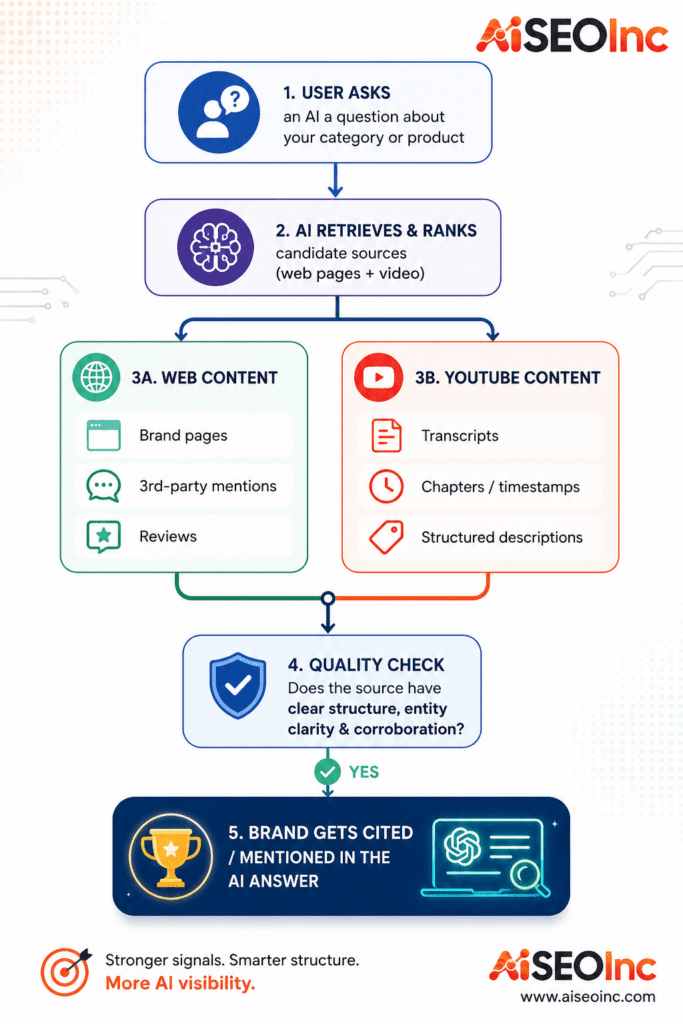
This is exactly the kind of dual-surface visibility gap most brands don’t know they have, until a competitor closes it first.
Our understanding of how this process works enables us to optimize brand strategies to ensure visibility across AI platforms.
Audit My AI Visibility
Why Brand Mentions Matter for AI Brand Visibility Beyond YouTube
It is a common misconception that “just go make YouTube videos and ignore everything else.” Always remember, branded web mentions are the second-strongest signal, and that pattern holds across every AI platform tested. More web mentions consistently mean more visibility, not just inside AI Overviews, but across ChatGPT and AI Mode too.
A Statista report suggests Reddit dominated overall citation volume while YouTube grew rapidly and LinkedIn remained a steady credibility layer. It suggests that AI visibility isn’t won on a single platform, but on a brand’s combined footprint across the platforms AI engines already trust.
In other words, YouTube is the strongest single lever, but it works best as part of a wider mention strategy, not a replacement for one.
What Doesn’t Move the Needle (And Why That’s Good News)
You don’t need a huge marketing budget to improve your AI visibility. Having backlinks and publishing content do help, but you can enhance your strategy with creative tactics.
If you’ve spent years assuming you need a 10,000-page content library and an aggressive link-building campaign to compete for AI visibility, that’s good enough. However, going the extra mile will surely help, considering how SEO has changed.
Researchers have highlighted a broader pattern in 2026. One widely cited analysis found that content length has essentially zero correlation with AI citations, and that 53% of all AI Overview citations go to pages under 1,000 words. It directly contradicts the old SEO instinct that “longer always wins.”
This is a genuinely different game from the one most SEO teams were trained to play. The brands winning AI visibility in 2026 aren’t necessarily the ones with the biggest content libraries or the most backlinks. They’re the ones structured for citation.
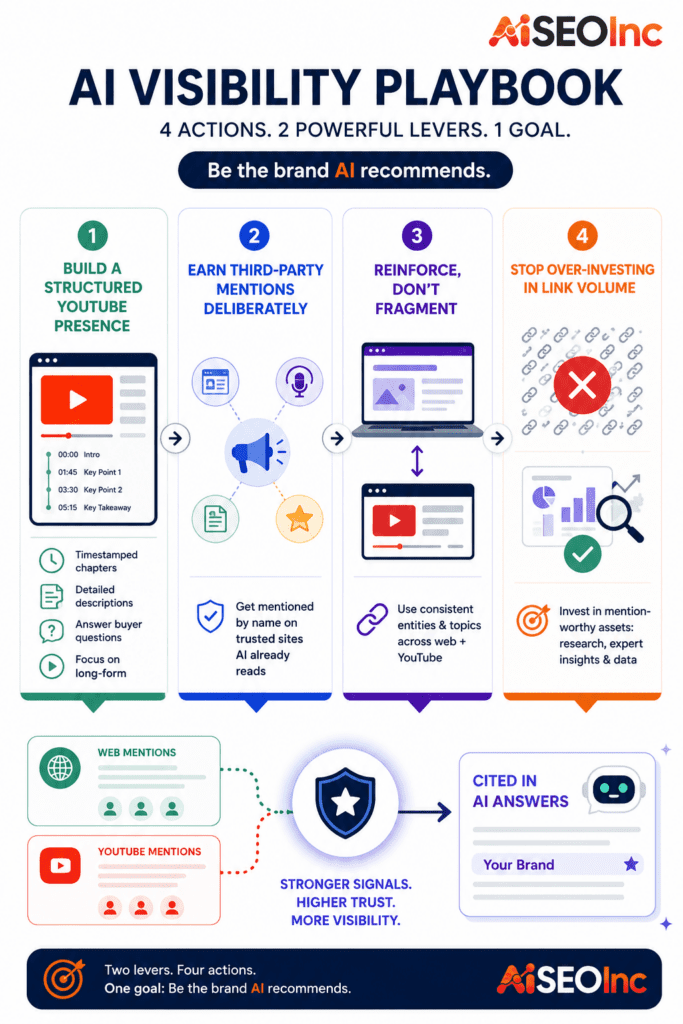
Top 4 Actionable AI SEO Strategies to Increase AI Brand Visibility
If YouTube mentions and branded mentions are the two strongest levers, here’s how to actually pull them.
1. Build a structured YouTube presence, even a small one
You don’t need a large channel to show up in AI answers. You need videos that are easy for an AI model to extract information from:
- Add timestamped chapters to every video. They function as headers an AI system can parse and cite individually.
- Write long, detailed descriptions that summarize the video the way a Wikipedia entry would, not the way a marketing blurb would.
- Cover the exact questions your buyers ask AI tools, comparison videos, “how X works” explainers, and tutorials consistently outperform promotional content for citation purposes.
- Stick to long-form. Across multiple independent studies, the vast majority of AI-cited YouTube content is long-form, not Shorts.
2. Earn third-party mentions deliberately, not opportunistically
Since branded web mentions are the second-strongest factor, every PR placement, guest post, podcast appearance, and review profile is doing double duty. It is both for human trust and AI training data. Prioritize being mentioned by name on sites AI models already trust and cite frequently, rather than chasing link volume for its own sake.
3. Reinforce, don’t fragment
Cover the same core topics on your site and on YouTube, using consistent entity language (your brand name, product names, and category terms) across both. AI engines pull from web and video sources in parallel, and consistent signals across both surfaces compound your odds of being the one mentioned.
4. Diversify your investment
Backlink acquisition is essential, but you must also diversify your investments. Consider mention-worthy assets, such as original research, expert commentary, and citable data (much like the report this article is built on). Link volume metrics are sitting at the bottom of this list for a reason.
Why Choose AI SEO Inc?
Most agencies are still optimizing brands for a search landscape that’s already shifted underneath them. YouTube structure, branded mentions, and citation-worthy content now outweigh the backlink-and-page-volume tactics that defined SEO for two decades.
At AI SEO Inc, this is precisely the gap we built our methodology to close. Our proprietary AI Visibility Intelligence System continuously monitors how generative engines interpret your category, and maps which competitors are getting cited instead of you. Additionally, it tracks the authority signals, YouTube mentions included, that correlate with actually being mentioned by name.
If your brand isn’t showing up when customers ask ChatGPT, Gemini, or AI Overviews who to trust in your category, that’s not just due to content. It has to do with visibility architecture and the best part? It can be fixed.